Case report | DOI: https://doi.org/10.31579/2640-1045/177
Family Physician & Public Health Consultant, Bengaluru.
*Corresponding Author: Suresh Kishanrao, MD, DIH, DF, FIAP, FIPHA, FISCD, Family Physician & Public Health Consultant, Bengaluru.
Citation: Suresh Kishanrao, (2024), Subclinical Hypothyroidism in Adults- to Treat or Not? J. Endocrinology and Disorders, 8(2): DOI:10.31579/2640-1045/177
Copyright: © 2024, Suresh Kishanrao. This is an open-access article distributed under the terms of the Creative Commons Attribution License, which permits unrestricted use, distribution, and reproduction in any medium, provided the original author and source are credited.
Received: 18 March 2024 | Accepted: 28 March 2024 | Published: 08 April 2024
Keywords: euthyroid; subclinical hypothyroidism (scht); overt hypothyroidism; iodine intake; normative ranges; prevalence; autoimmunity; levothyroxine; population screening tests
Background: Subclinical hypothyroidism (ScHt) is a condition in which the Laboratory reports show normal T3 or FT3, normal T4 or FT4, and increased TSH concentrations, associated with few or no signs & symptoms of hypothyroidism. ScHt prevalence is estimated to be ranging from 4% to 20% of adults, with a higher prevalence in women, older people, and those with thyroid autoimmunity. It is higher in iodine-sufficient areas and genetics also plays a role.
ScHt can progress to overt hypothyroidism, especially if antithyroid antibodies are present. It has been associated with adverse metabolic parameters like dyslipidaemia, reproductive, maternal-foetal, cardiovascular, neuromuscular, and cognitive abnormalities. ScHt among pregnant women is significant as the prevalence of overt & ScHt among them is reported to be 2.5 % and almost fourfold (9.54%) respectively. The good news is that half of the cases resolve spontaneously in within 2 years.
Methods & Materials: This article is an outcome of literature review following the author and his son’s annual blood test results showing indications of ScHt in late February 2024.
Results: The results of annual blood tests in a recognised laboratory showed TSH levels of 6.233 and 7.529 respectively for the author and his son respectively. The authors Hb1Ac were 6.4 despite being just on oral anti-diabetics (with diet control and exercise routine) since 1991, indicative of a good management. It was surprising to note that both have ScHt. However, after an intensive literature search and discussions decided for “a wait and watch strategy” instead for jumping for treatment.
Conclusion: In India 4% to 20% of adults have subclinical hypothyroidism, with a higher prevalence in women, older people, and those with thyroid autoimmunity. Though ScHt can progress to overt hypothyroidism, especially if antithyroid antibodies are present, half of the cases are expected resolve spontaneously in within 2 years. As most endocrinologists, Cardiologists and Public health professionals in India do not recommend treatment for 1-2 year unless either i) when TSH >10 mIU/L, or signs become explicit, or ii) Cardiovascular risk individuals, we have decided to monitor the progress for entire 2024 with quarterly assessments of the parameters.
SAMA= Serum antimicrosomal antibodies, S. anti-TPO= anti-thyroid peroxidase autoantibody, GOI= Government of India, TSH= Thyroid Stimulating Hormone, T3=Triiodothyronine, T4= Thyroxine, CABG= Coronary artery bypass grafting, NFHS=National Family Health Survey,
The prevalence of self-reported goitre or thyroid disorder in National Family Health Survey was 2.7 % for women and 0.5 % for men in NFHS-V report (2019-2021) in 15-49 years age group in India as compared to 2.2% in NFHS IV report (2015-2016)] was among women and 0.5 % among men in the age group of 15-49 years. The data indicates an increase in women by about 22.7% and stationary at 0.5% among men over 5 years [1]. The community based serological data is lacking in the country. However, various clinical and epidemiological studies conducted across India have shown a prevalence rate varying between 6% and 15%.
Subclinical Hypothyroidism (ScHt)’s is based on biochemical profile as of now! Subclinical hypothyroidism is defined as normal T3 or FT3, normal T4 or FT4, and increased TSH concentrations, associated with few or no signs & symptoms of hypothyroidism. Its incidence increases with advanced age, female gender, and greater dietary iodine intake and in individuals with metabolic syndrome, thyroid impairment is frequent. National guidelines use goitre as the key sign for self or community-based reporting, most of the ScHt patients do not have goitre (stage 0- 60%) or stage 1 goitre (21%), rest of 19% having Gr I to Gr iii goitre, whereas, among biochemically euthyroid subjects 9% stage I or II goitre [2,6].
ScHt is estimated to affects 3–15% of the adult population in India [3,4]. Mean S.TSH in our population is 2.22 μlu/mL (euthyroid outliers: 0.3–4.6 μlu/mL); therefore, S.TSH levels above 4.6 μlu/mL is considered abnormal [4,13,14]. The prevalence of thyroid autoimmunity increases after age of 35 years. ScHt presents mainly in agoitrous form and with positive antibodies, due to autoimmunity [5]. Serum thyroid autoantibody titres {antimicrosomal antibodies [S.AMA]}, and anti-thyroid peroxidase autoantibody [S. anti-TPO]) are used to diagnose the subclinical cases. ScHt can progress to overt hypothyroidism, especially if antithyroid antibodies are present, and has been associated with adverse metabolic parameters like dyslipidaemia (7,8) reproductive, maternal-foetal [6,7], cardiovascular [9], neuromuscular, and cognitive abnormalities [8]. ScHt among pregnant women is significant as the prevalence of overt & ScHt among them is reported to be 2.5 % and almost fourfold (9.54%) respectively [6].
As ScHt is recognized only in laboratory tests, no one seeks care, and often goes away on its own with time. Most endocrinologist, Cardiologists and Public health professionals in India do not recommend treatment for 1 year unless either i) when TSH >10 mIU/L, or signs become explicit, or ii) Cardiovascular risk individuals. Current thinking is to treat it with levothyroxine if it persists after repeated laboratory examination. In older adults with subclinical hypothyroidism, the mildly raised TSH levels may become normal in at least half of the cases within 1-2 years, according to a study published recently [10]. In milder ScHt cases, a wait-and-watch strategy is advocated [12,13,14].
Therefore, it is time debate and decide when to treat ScHt.
This article as an outcome literature review after the authors and his son’s February 2024 annual blood test indicated S.TSH levels above 4.6 μlu/mL and Free T3 & T4 being normal.
Case Reports: In routine annual check of my entire family went through and comprehensive annual checkup on 24 February I was surprised to see some parameters abnormal and most striking among them was an indication of Subclinical Hypothyroidism in myself and my sons Parameters. Both of us have familial Minor Thalassemia.
Self: I am diabetic since 1991 relatively well managed keeping Hb1Ac around 6.5 since last 2 years after it had reached over 7.5 in 2021. While this time in February 2024 my Hb1Ac is 6.6 and FBS 147. Having undergone CABG operation in June 2005 and a Post CABG Angio in February 2023, I had opted for strict diet management including intermittent fasting and increasing fruit consumption to the extent that My breakfast has been 0.5 kg of papaya fruit daily. All other parameters were in acceptable range except TSH which was 6.233 as against a range of 0.55-4.78 and T3 was 10.7, T4 6.5 and TSH 6.2333 uIU/ml. Surprised I checked my 2023 report 17 February 2023 which showed Triglycerides as 3.8 uIU/ml and T3 T 4 also in normal range. In my case 162% increase in TSH level over a year is concerning
On the other hand, my son aged 36-years has no clinical symptoms or signs of any metabolic disorder also showed a raised TSH 7.529 uIU/ml, with normal T3 -1.48 ng/mL, T4- 7.529uIU/ml. All other parameters were normal. His previous report of 26 May 2022 also had shown T4= 1.76 ng/mL, T4= 10.98 µg/dl and TSH= 6.433 uIU/ml. In May I had missed his reporting to ScHt, which continued to increase to a TSH of 7.529, fortunately still not signalling the need for the treatment. His TSH went up by 117% over 1 year and 9 months.
My wife’s report has dyslipidaemia indication, but her Thyroid functions are normal.
However, this suspicion of ScHt in two of the three led me to do the literature review about when to start treating the condition and the subject of this article for alerting everyone!
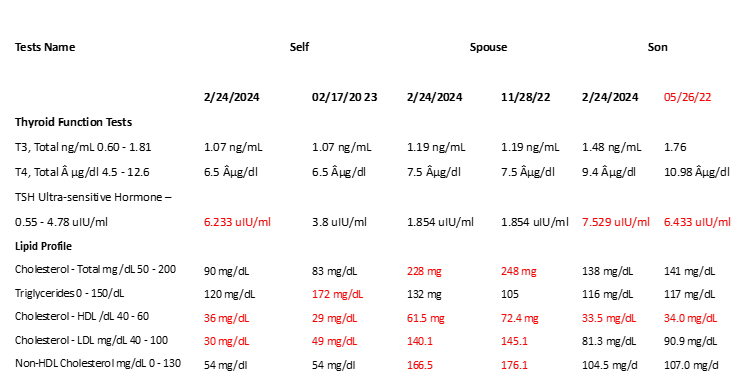
Table 1: Comparative Statements of Key Lab Findings with immediate previous Reports
The thyroid gland is one of the largest and ductless glands of the endocrine glands, situated in the front portion of the neck and resembles the shape of a butterfly. This gland is responsible for the production of two main thyroid hormones called T3 (Triiodothyronine) and T4 (Thyroxine). The thyroid hormones are mainly involved in the regulation of many functions and aspects of the human body, such as regulation of i) Bone density ii) Body weight iii) Energy levels iv) Body temperature v) Growth of hair and nails. Hyperthyroidism, is a hormonal disorder caused by the excessive production of T3 and T4 hormones from the thyroid gland, caused by an auto-immune disorder and females are at higher risks compared to males. Complications related to excessive production of thyroid hormones are excessive hair fall, less or frequent periods, infertility, osteoporosis, brittle bones, weakness, etc. On the other hand, the enlargement of the thyroid gland irrespective of its pathology is called goitre. This is more common in females than males, especially after the age of 40 years, i.e., after menopause. Our thyroid needs iodine to produce thyroid hormone. If we don't get enough iodine in our diet, our thyroid makes grows and to try to make more thyroid hormone, a most common cause of goitre, The goitre is the most frequent clinical manifestation of the nutritional deficiency of iodine. If present in more than 5% of the general population or more than 10% of the children in school of a defined geographic area, goitre is defined endemic. Over time, the thyroid gland may stop making enough thyroid hormone and resulting in hypothyroidism.
Subclinical Hypothyroidism (ScHt)’s is based on biochemical profile. ScHt is defined as normal T3 or FT3, normal T4 or FT4, and increased TSH concentrations, associated with few or no signs & symptoms of hypothyroidism [2,3,4].
The natural course of ScHt Subclinical” suggests that the disease is in its early stage, with changes in TSH apparent but decreases in thyroid hormone levels not explicit. Subclinical hypothyroidism can progress to overt hypothyroidism, although it has been reported to resolve spontaneously in half of cases within 2 years in patients with TSH values of 4 to 6 mIU/L. The rate of progression to overt hypothyroidism is estimated to be 33% to 55% over 10 to 20 years of follow-up. The risk of progression to clinical disease is higher in patients with thyroid peroxidase antibody, reported as 4.3% per year compared with 2.6% per year in those without this antibody. In one study, the risk of developing overt hypothyroidism in those with subclinical hypothyroidism increased from 1% to 4% with doubling of the TSH. Other risk factors for progression to hypothyroidism include female sex, older age, goitre, neck irradiation or radioactive iodine exposure, and high iodine intake [14].

Prevalence of thyroid disorders at the community level among adult people in India, was studied using Random cluster sampling strategy in Cochin Kerala in 2013 on 971 adult subjects’ The results showed a prevalence of hypothyroidism was 3.9%.[3]. The prevalence of subclinical hypothyroidism was also high in this study, the value being 9.4%. In women, the prevalence was 11.4%, when compared with 6.2% in men. The prevalence of subclinical hypothyroidism increased with age. About 53% of subjects with subclinical hypothyroidism were positive for anti-TPO antibodies. In this study, Urinary Iodine Status was studied in 954 subjects from the same population sampled, and the median value was 211 μg/l; this suggested that this population was iodine sufficient [3].
The study also analysed the symptoms of Thyroid disorders as shown in the graph by the side. As of now I occasionally feel my voice becoming hoarse if I talk loudly and excessive sweating. My son has absolutely none of these symptoms. On the contrary we both excessive hair growth over head and all parts of the body

The term "metabolic syndrome" refers to a group of disorders that include weight gain, hypertension, an abnormal lipid profile with high triglyceride (TG) levels and low levels of high-density lipoproteins (HDLs), and higher fasting blood sugar (FBS) levels [7]. The incidence increased globally from 1.1% in 1980 to 3.85% in 2015 over the past three decades, contributing to high body mass index (BMI) related mortality rates (cause specific) increase by 28.3
From 4% to 20% of adults have subclinical hypothyroidism, with a higher prevalence in women, older people, and those with thyroid autoimmunity.
It is higher in iodine-sufficient areas, and it increases in iodine-deficient areas with iodine supplementation.
Genetics also plays a role, as subclinical hypothyroidism.
A difficulty in estimating the prevalence is the disagreement about the cutoff for TSH, which may differ from that in the general population in certain subgroups such as adolescents, the elderly, and pregnant women.
Subclinical hypothyroidism can progress to overt hypothyroidism, especially if antithyroid antibodies are present, and has been associated with adverse metabolic, cardiovascular, reproductive, maternal-foetal, neuromuscular, and cognitive abnormalities.
Further trials are needed to clearly demonstrate the clinical impact of subclinical hypothyroidism and the effect of levothyroxine therapy.
Due to apparently asymptomatic nature of the illness, the “American Thyroid Association” (ATA) has recommended routine population screening of both sexes at age 35 years and then every 5 years thereafter for early detection and treatment of ScHt.
National and State Health Departments must collate the Laboratory data (Private and Public sector) Lipid and Thyroid parameters across the country and assess current situation.
For future the author recommends, that GOI and States to take up population-based studies at least in known Goitre endemic districts of the country to start with.
Making the screening facility available in all public Sector facilities across in India urgently.
Until such time individuals over 35 years must get routine screening done and treat if needed
Dear Editorial Team, Clinical Medical Reviews and Reports. My experience with the journal was highly positive. The peer-review process was rigorous, constructive, and completed in a timely manner. The reviewers provided valuable comments that helped improve the quality and clarity of our manuscript. The editorial office was professional, responsive, and supportive throughout all stages of the publication process. Communication was clear and efficient, and any questions were addressed promptly. Overall, I found the journal to maintain high scientific standards and an excellent publication workflow. I would be pleased to consider submitting future work to this journal. Best wishes from, Elena Popa.

It was my pleasure to submit my testimonial concerning the Reviewer Board of our Scientific Journal “Brain and Neurological Disorders”. The Reviewers focused on some modifications and their contribution was helpful. The ladies of our Editorial Office were also supported my efforts. It was my honor to have such a co-operation and I am looking forward for more collaboration.
Dear Grace Pierce, Editorial Coordinator of Journal of Clinical Research and Reports, Thank you for the speedy and efficient peer review process. I appreciate the fact that your peer reviewers do not take months to respond like with some other journals. I would also like to thank the editorial office for responding quickly to my questions. It is an excellent journal. I plan to submit more manuscripts in the future. Best wishes from, Robert W. McGee

Dear Grace Pierce, Editorial Coordinator of Journal of Clinical Research and Reports, Working with you and your team on our recent publication in JCRR has been a truly wonderful and enjoyable experience. The responses were prompt, and the reviewers were patient, constructive, and highly professional. One reviewer in particular gave me the feeling that a professor was carefully reading and commenting on my coursework, which was deeply touching. The entire process was straightforward and hassle‑free, with no tedious online forms to complete. I highly recommend this journal. Best wishes from, DR Aibing Rao, Head of R&D

I Appreciate the Opportunity to Share my Experience with the Journal of Clinical Research and Reports. The peer review process was timely and constructive, and the feedback provided helped improve the quality of our manuscript. The editorial office was professional, responsive, and supportive throughout the process, ensuring smooth communication and efficient handling of the submission. Overall, it was a positive experience collaborating with your team.
Dear Mercy Grace, Editorial Coordinator of Obstetrics Gynecology and Reproductive Sciences, We would like to express our gratitude for your help at all stages of publishing and editing the article. The editors of the magazine answer all the necessary questions and help at every stage. We will definitely continue to cooperate and publish other works in the Obstetrics Gynecology and Reproductive Sciences! Best wishes from, Alla Konstantinovna Politova,