Research Article | DOI: https://doi.org/10.31579/2641-0419/018
1 División de Cardiología. HospitalGeneral deAgudos J.M. Ramos Mejía. Ciudad Autónomade Buenos Aires.
2 Servicio de Diabetes y Nutrición. HospitalGeneral de AgudosJ.M. Ramos Mejía.Ciudad Autónoma de Buenos Aires.
3 Academia Nacionalde Medicina . Argentina.
4 Instituto de Investigaciones Cardiológicas Prof. Dr. AlbertoTaquini. Facultad de Medicina. Universidad de Buenos Aires.
*Corresponding Author: Carbajales J, División de Cardiología. Hospital General de Agudos J.M. Ramos Mejía. Ciudad Autónoma de Buenos Aires.
Citation: Carbajales J, Principato MB , Duarte A , Tomatti AL, Paolucci AG. Title: Relationship between the Aingle Nucleotide Polymorphism rs4704963 (t> c) of the early b-cell Factor 1 gene and Smoking in a Population with Risk Factors for Coronary Heart Disease with and without Acute Coronary Syndromes Treated in Buenos aires city, Argentina. J.Clinical Cardiology and Cardiovascular Interventions,2(1);Doi:10.31579/2641-0419/018
Copyright: © Carbajales J. This is an open-access article distributed under the terms of the Creative Commons Attribution License, which permits unrestricted use, distribution, and reproduction in any medium, provided the original author and source are credited.
Received: 05 September 2019 | Accepted: 17 September 2019 | Published: 04 October 2019
Keywords: acute coronary syndromes ; coronary heart disease; nucleotide polymorphism
Introduction: Early B-cell factor 1 (EBF1) gene participates in the development of the central nervous system and is expressed in adipocytes and olfactory neuroepithelium, which is intimately linked with the emotion and reward system in adults. For this reason, it could be linked to tobacco addiction
Objective: The aim of this study was to determine probable association between the EBF1 gene rs4704963 SNP (T>C) with smoking habits in a population of patients with multiple coronary risk factors (CRF) with and without acute coronary syndromes (ACS).
Materials and methods: Between December 2015 and March 2017, 104 consecutive patients with two or more risk factors, with or without ACS were included. A 10-mL blood sample was collected from all the patients for SNP determination. DNA genotyping was carried out using the nested PCR technique and subsequent sequencing.
Results: Mean age was 59.1 ± 9.17 years and 59.6% were men. The most common CRF were smoking habits (60.6%) hypertension (56.7%) and diabetes (48.1%).None of the patients had the homozygous T / T haplotype while 17 patients (16.3%) presented the T / C haplotype for heterozygous SNP. Among the 17 patients with the SNP detected, 16 (94.1%) were smokers compared to 54% of smokers in those patients without the SNP detected (p = 0.002).
In those patients with ACS and smoking habits, the SNP was detected in 21.3% versus 0% in those with ACS and no history of smoking habits (p= 0.029)
Conclusion: A significant association was observed between the EBF1 gene rs4704963 SNP (T> C) with smoking habits in patients with ACS and in those with CRF without ACS. Further research including more patients is necessary to confirm these findings in order to customize decision-making to prevent this addiction and indicate the appropriate treatment when smoking is present.
Tobacco is one of the greatest threats to public health the world has to cope with, with more than seven million deaths per year, including six million deaths due to direct tobacco use and around 890,000 attributable to environmental tobacco smoke.
In 2000, 27% of the world population smoked compared to 20% in 2016 [1]. In Argentina, 40,000 people die per year as a result of tobacco use and 6000 due to passive smoking [2].
In terms of public health policies, it would be important to identify those persons genetically predisposed to develop addiction in order to design preventive actions and gene therapies.
The contribution of genetic determinants in nicotine addiction has been a subject of research for many years, with evidence about the determining role of some genes in such addiction.
In 1958, Fisher described the possible association between genome, tobacco use and lung cancer; later, he conducted a study on monozygotic and dizygotic German male twins and reported that the concordance of smokers was greater among monozygotic twins than among dizygotes [3].
The study of nicotinic receptors has become increasingly important; the most conclusive findings were related to cholinergic nicotinic receptor subunit (CHRNA)3, CHRNA4 and CHRNA5 genes and to the associations between the CHRNB3-CHRNA6 genes and CHRNA5 ‑CHRNA3 ‑ CHRNB4 genes [4].
In 2008, Ovide F. Pomerleau et al. reported that polymorphism in the CHRNA5 sub-unit was significantly associated with better pleasurable responses to initial cigarettes in regular smokers, in an a priori test. These findings suggest that subjective experiences about experimentation with smoking may mediate the development of nicotine dependence [5].
Thanks to genomics, we now know that the susceptibility of patients to polygenic diseases, as most cardiovascular diseases, may be due to the fact that the genes involved have single nucleotide changes along their structure called SNP (single nucleotide polymorphism) with a frequency in the population greater than 5%. Therefore, the importance of detecting such SNPs is significant [6].
This association of polymorphisms has also been observed with addictions, as in the case of SNP in the catechol-O-methyltransferase (COMT) and CHRNA5 genes that is associated with tobacco addiction [7,8,9].
Although the early B-cell factor 1 (EBF1) gene participates in the development of the central nervous system and is expressed in adipocytes and in olfactory neuroepithelium (intimately linked with the emotion and reward system) in adults [10], its possible relationship with tobacco addiction had not been previously explored.
The aim of our study was to investigate the probable association between the EBF1 gene rs4704963 SNP (T>C), the most common EBF1 gene SNP, with smoking, in a population of patients with multiple coronary risk factors (CFR) with and without acute coronary syndrome (ACS).
We conducted an observational and prospective study to determine the prevalence of polymorphism in a population of smokers, with or without ACS. The study population was made up of 104 patients who were treated in the Department of Cardiology at the Ramos Mejía Hospital in the city of Buenos Aires, Argentina. Patients who presented ≥ two CRF with or without ACS were consecutively included between December 2015 and March 2017.
All the patients included were men and women > 18 years and were categorized as follows:
Smokers: current smokers or former smokers who had quit smoking one year before or greater.
Non-smokers: patients who had never smoked.
Patients who refused to sign the informed consent form and those with a history of severe known conditions (excluding cardiovascular diseases), or with life expectancy < one> than 2 mg /dL).
All the patients signed an informed consent form. The protocol was approved by the institutional Committee on Ethics.
A10-mL blood sample was collected from all the patients for SNP determination. For the genetic analysis, DNA was isolated using a commercially available Wizard® Genomic DNA Purification Kit from Promega.DNA concentration was estimated by measuring the absorbance in nanodrop (De novix) at 260nm.This DNA was used to amplify the segment of interest by means of a nested polymerase chain reaction (PCR) in order to increase specificity and reduce sequencing costs.
The following primers (Genbiotech) were used for the first PCR reaction: First forward: 5`AGGAGAACATGCTTTGCCGT3`; First reverse: 5`AGACACTTCAGGCTGACACA3` and the PCR reaction was carried out under the following conditions: 1- initial denaturation at 94 ° C for 2min, 2- denaturation at 92 ° C for 15 sec, 3- pairing at 55 ° C for 15 s, 4 - extension at 68 ° C for 70 s, 5- final extension at 68 ° C for 5 min. Items 2, 3 and 4 were repeated 35 times (35 cycles).
The following primers (Genbiotech) were used for the second PCR reaction: First forward: 5`GCCAGGATTCACTATCTTTGGAC3`; First reverse: 5`ACAGCTCTAAGCTTCCTCCC3` and the PCR reaction was carried out under the following conditions: 1- initial denaturation at 94 ° C for 2min, 2- denaturation at 92 ° C for 15 s, 3- pairing at 53 ° C for 15 s , -4- extension at 68 ° C for 30 s, -5- final extension at 68 ° C for 5 min. Items 2, 3 and 4 were repeated 35 times.
Amplicon was sequenced on the Macrogen platform. With the results obtained, the presence of the polymorphism of interest was evaluated using the DNA Baser software.
All the calculations were performed with the SPSS software package, version 22.0 (SPSS Inc., Chicago, IL, USA).
Continuous variables were expressed as mean ± standard deviation, while categorical variables were expressed as absolute and relative frequencies.
The chi square test was used to evaluate the association between polymorphism and the presence of ACS. The relative risk (OR) was calculated with a 95% confidence interval (CI). A p value ≤ 0.05 was considered statistically significant.
Mean age was 59.1 ± 9.17 years and 59.6% were men. Acute coronary syndrome was identified in 65.4% of the patients whose mean age was 59 ± 8.83 years and 75% were men; 34.6% presented CRF without ACS with a mean age of 59.5 ± 9.88 years and 30.6% of these patients were men.
Of the 104 patients, the prevalence rates of CRF were estimated to be48.1% for diabetes (DBT), 56.7% for hypertension (HT), 45.2% for dyslipidemia (DLP), 38.5% for obesity and 60.6% for smoking habits (Table 1).Age (mean ± SD)

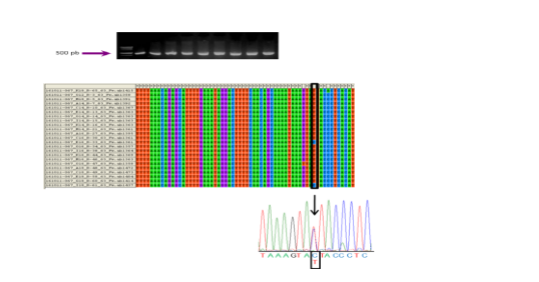
None of the patients had the homozygous T / T haplotype while 17 patients (16.3%) presented the T / C haplotype for heterozygous SNP (Figure 1).
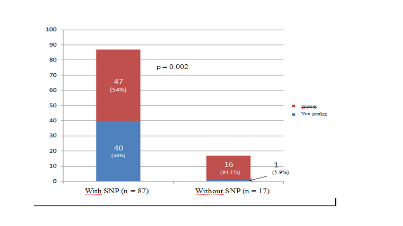
Among the 17 patients with the SNP detected, 16 (94.1%) were smokers compared to 54% of smokers in those patients without SNP detected (p = 0.002) (Figure 2).
In those patients with ACS and smoking habits, the SNP was detected in 21.3% versus 0% in those with ACS and no history of smoking habits (p= 0.029)
In this study, we tried to determine the prevalence of EBF1 gene rs4704963 SNP (T>C) in smokers and non-smokers and its association with the presence of ACS, considering a dominant genetic model.
EBF1 is a member of the EBF family of genes, which is widely expressed in many tissues such as B lymphocytes, bone marrow, olfactory neurons and adipocytes [11]. This gene plays an important role in promoting adipogenesis [12]. It has been shown that leptin concentrations were significantly decreased in knockout mice for EBF1 [13]. Leptin produced in adipocytes is an essential hormone for the prevention of obesity, since it regulates energy expenditure, appetite and metabolism, and leptin deficits result in the development of obesity.
Shah et al. studied families with high LDL-cholesterol levels and found an association with changes in the long arm of chromosome 5 (5q.) which is the genomic location of the EBF1 gene [14].
Subsequently, Nolan et al. showed that variations in genes located on a portion of chromosome 5 (5q31-33), as the EBF 1 gene, were related to early onset of cardiovascular disease [15]. Moreover, the rs4704963 SNP (T>C), evaluated in our study is one of the polymorphisms associated with atherosclerosis and cardiovascular disease [16].
This study explored the possible relationship between EBF1 gene polymorphism and tobacco addiction. As EBF1 gene is expressed in the olfactory neuroepithelium and it has been hypothesized that olfactory neuroepithelium abnormalities may generate susceptibility to tobacco addiction.
Our results show a high prevalence of the SNP analyzed in the total population :17 patients (16.5%) presented T / C haplotype for heterozygous SNPA more significant finding was that among the 17 patients who had the SNP, the prevalence of smokers was significantly higher (n = 16, 94.1%) versus those without the SNP (54%; p= 0.002).
Also the SNP was detected in 21.3% of the patients with ACS and smoking habits, versus 0% in those with ACS and no history of smoking habits (p= 0.029)
These findings would be consistent with Fisher's initial statement [3] about the possibility that the same genes would determine susceptibility to tobacco use and to the development of tobacco-related diseases.
Further research including more patients is necessary to confirm these findings, in order to make a thorough analysis of the characteristics of the smoking habits of those affected by this addiction. This will allow us investigate the possible relationship between these polymorphisms and the intensity of tobacco use, nicotinic dependence and the result of smoking cessation treatments.
The results of this study are the first reported about the association between the EBF1 gene rs4704963 SNP (T> C) with smoking habits, in patients with CRF with or without ACS. These encouraging results need to be confirmed with greater number of patients in order to demonstrate the effectiveness of genetic tests to customize decision-making to prevent this addiction and indicate the appropriate treatment when smoking is present.
The research was conducted following the Resolution 1490/07 of the Ministry of
Health that approved the “Guidelines for Good Clinical Practice in Research on Human Subjects”, and the internationally recognized Good Clinical Research Practice (GCP-ICH), the recommendations of the declarations of Nuremberg, Helsinki with the corresponding amendments (Washington 2002, Tokyo 2004, Seoul 2008 and Fortaleza 2013) and the Law 3301 of the Government of the City of Buenos Aires regarding the “Protection of Rights of Subjects in Research ".
The study was approved by the Committee on Ethics of the Ramos Mejía Hospital.
Patients were asked to sign an informed consent form and received the original document.
The patients were identified by their initials, by a number and by the group to which they belonged, and the real identity was only known by the investigator to protect the confidentiality of all the information according to the Argentine personal data protection law 25,326.
Dear Editorial Team, Clinical Medical Reviews and Reports. My experience with the journal was highly positive. The peer-review process was rigorous, constructive, and completed in a timely manner. The reviewers provided valuable comments that helped improve the quality and clarity of our manuscript. The editorial office was professional, responsive, and supportive throughout all stages of the publication process. Communication was clear and efficient, and any questions were addressed promptly. Overall, I found the journal to maintain high scientific standards and an excellent publication workflow. I would be pleased to consider submitting future work to this journal. Best wishes from, Elena Popa.

It was my pleasure to submit my testimonial concerning the Reviewer Board of our Scientific Journal “Brain and Neurological Disorders”. The Reviewers focused on some modifications and their contribution was helpful. The ladies of our Editorial Office were also supported my efforts. It was my honor to have such a co-operation and I am looking forward for more collaboration.

Dear Grace Pierce, Editorial Coordinator of Journal of Clinical Research and Reports, Thank you for the speedy and efficient peer review process. I appreciate the fact that your peer reviewers do not take months to respond like with some other journals. I would also like to thank the editorial office for responding quickly to my questions. It is an excellent journal. I plan to submit more manuscripts in the future. Best wishes from, Robert W. McGee

Dear Grace Pierce, Editorial Coordinator of Journal of Clinical Research and Reports, Working with you and your team on our recent publication in JCRR has been a truly wonderful and enjoyable experience. The responses were prompt, and the reviewers were patient, constructive, and highly professional. One reviewer in particular gave me the feeling that a professor was carefully reading and commenting on my coursework, which was deeply touching. The entire process was straightforward and hassle‑free, with no tedious online forms to complete. I highly recommend this journal. Best wishes from, DR Aibing Rao, Head of R&D

I Appreciate the Opportunity to Share my Experience with the Journal of Clinical Research and Reports. The peer review process was timely and constructive, and the feedback provided helped improve the quality of our manuscript. The editorial office was professional, responsive, and supportive throughout the process, ensuring smooth communication and efficient handling of the submission. Overall, it was a positive experience collaborating with your team.

Dear Mercy Grace, Editorial Coordinator of Obstetrics Gynecology and Reproductive Sciences, We would like to express our gratitude for your help at all stages of publishing and editing the article. The editors of the magazine answer all the necessary questions and help at every stage. We will definitely continue to cooperate and publish other works in the Obstetrics Gynecology and Reproductive Sciences! Best wishes from, Alla Konstantinovna Politova,