Research Article | DOI: https://doi.org/10.31579/2693-2156/001
*Corresponding Author: Nasser Al Busaidi, Senior consultant pulmonologist at Royal Hospital, Muscat Sultanate of Oman.
Citation: Yasmeen Al Rawahi, Nasser Al Busaidi. Pirfenidone Experience in Idiopathic Pulmonary Fibrosis at a Tertiary Hospital in Oman. J Thoracic Disease and Cardiothoracic Surgery, 1(1); DOI: 10.31579/2693-2156/001
Copyright: © 2020 Nasser Al Busaidi. This is an open access article distributed under the Creative Commons Attribution License, which permits unrestricted use, distribution, and reproduction in any medium, provided the original work is properly cited.
Received: 31 January 2020 | Accepted: 12 February 2020 | Published: 17 February 2020
Keywords: idiopathic pulmonary fibrosis; anti-fibrotic drugs; perifendone; FVC; 6MWT; safety; adverse events
Objective: The aim of this study is to evaluate the clinical and safety profile of Pirfenidone treatment in IPF.
Methodology: This is a retrospective analysis of prospectively collected data via electronic system called “Al Shifa”. Data of all patients, who received Pirfenidone at the Royal Hospital in the period between April 2012 to April 2017, were retrieved into an excel sheet. The data retrieved at two time points: before starting the drug and last readings at time of the study.
Results: There were 90 patients with IPF that were treated with Pirfenidone, The age ranges between 35 to 91 years old. All patient assessed by Forced Vital Capacity (FVC) by spirometry, and 6-minutes’ walk test (6MWT). The mean percentage of pre- FVC (before starting the drug) was 59.3%, while follow-up FVC (the last reading at the time of entering the data) was 60.3%. The Pre-6MWT test; the mean of distance they manage to walk in 6 mints, was 339 meters, and follow-up-6MWT test was 320 meters, the difference between pre and post result in both tests are insignificant and hence these results indicated the stability of the disease. Also, only 16.6% experienced drug adverse effect; 10% due to gastro-intestinal symptoms, 2.2% weight loss and 4.4% due to Photo-sensitivity.
Conclusion: Pirfenidone stabilized IPF patients, as there was no decline in lung functions test and exercise capacity was preserved as demonstrated by the 6MWT. Perifenidone was well tolerated with acceptable safety profile.
Advances in Knowledge
- The first report on the clinical efficacy and safety of Pirfenidone for the treatment of patients with IPF in our region
- Middle aged group with equal gender representation of IPF
- Criteria of IPF was fulfilled by 80% of patients based on high-resolution CT scan and/or lung biopsy
Application to Patient Care
- Pirfenidone stabilized IPF patients, with preserved lung functions test and exercise capacity as demonstrated by the 6MWT
- Only 16.6% experienced drug adverse effect; 10% due to gastrointestinal symptoms, 2.2% weight loss and 4.4% due to Photo-sensitivity
- Education of patients and close follow-up is of paramount importance to improve the clinical outcomes.
Idiopathic pulmonary fibrosis (IPF) is a chronic lung disease, the disease carries high mortality and morbidity and if left untreated it may end up with respiratory failure and death within few years of diagnosis [1]. IPF characterized by inflammatory process in the interstitium, this process triggered by unknown factors, the inflammation in the interstitium then will be replaced by fibrosis [2]. Among all idiopathic interstitial pneumonias, IPF is the leading cause of chronic lung fibrosis which commonly ended up with terminal lung disease and respiratory failure [3]. IPF is worse than many cancers as the the median survival from the time of diagnosis is 3 years and in the US 40,000 patients die because of IPF every year [4].
Clinical trials such as Capacity (004 & 006) suggested that Pirfenidone which is an anti-fibrotic and anti-inflammatory drug reduces the deterioration of patients with IPF in lung function and exercise capacity [5]. these result also supported by the findings in ASCEND Clinical Trials, these trials showed that patients with IPF on Pirfenidone when compared to placebo group it reduces the disease progression as seen in lung function, exercise capacity and progression free survival, this study also showed good safety profile of Pirfenidone [6]. Because of these encouraging results, pirfenidone is approved for the treatment of IPF in many countries. We found no studies were done in Oman about the clinical and safety profile of the use of Pirfenidone for the treatment of IPF.
Is to measure the safety and efficacy of Pirfenidone.
To measure the safety and efficacy of Pirfenidone in our patients and reporting side effect of Pirfenidone.
The efficacy of Pirfenidone in patient with IPF as assessed by lungs function test and 6MWT.
This is a retrospective analysis of data obtained prospectively via an electronic health system called “Al Shifa”. All patients with IPF are evaluated at the Royal Hospital, which is a tertiary care hospital located at the capital and the health care is free for all citizens from all over the country. Pirfenidone is only available at the Royal Hospital. The study analyzes the data of all patients seen in the period between April 2012 to April 2017. The data retrieved at two time points: before starting the drug and last readings at time of the study. All patient assessed by Forced Vital Capacity (FVC) by spirometry, and 6-minutes’ walk test (6MWT). All patients that continued using the drug till the time of data collection were included and those who stopped using the drug for a less than a year were excluded from the analysis but reasons for stoppage of drug were evaluated.
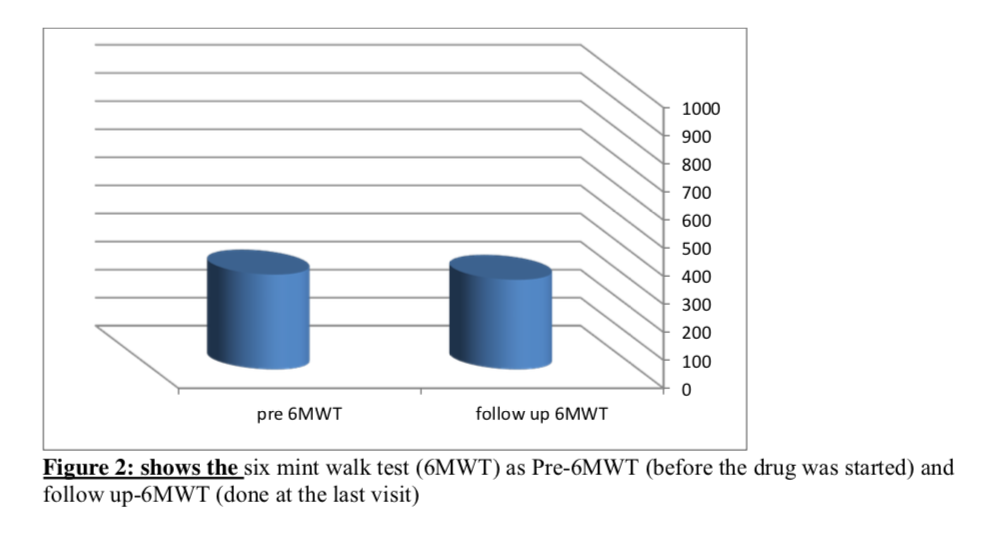
The efficacy of the drug was assessed by Forced vital capacity (FVC); one parameter of lung function test; by comparing the result of FVC before starting Pirfenidone (Pre-FVC) with the last test done for the patient (Follow up-FVC), the patient also assessed by six mint walk test (6MWT) as Pre-6MWT (before start the drug) and Follow up-6MWT (done at the last visit).
The study was approved by Royal Hospital ethics committee
Data analysis
All the parameters collected from al shifa computer health system into and excel sheet and then transfer into SPSS statistical program. tTe data was further analyzed using specific statistical formulas (e.g chi square and student t –test) as indicated.
During the study period of five years, 90 adult patients with diagnosis of Interstitial Lung Diseases (ILD) were managed with Pirfenidone. Their age ranges between 35 -91-year-old with mean (SD) of 64 (15) years and 50% were females. (as seen in table 1)

The criteria of IPF was fulfilled by 80% of patients based on high resolution CT scan and/or lung biopsy. The remaining 20% were not IPF; but had Usual Interstitial Pneumonitis (UIP) picture in HRCT with underlying Connective Tissue disease (CTD).
The doses of the Pirfenidone ranged between 1800 to 2400 mg per day in 57.8% of the patients and the rest received sub-optimal dose of the drug ranging between 800 mg to 1600 mg per day. 50% of the patients continued using the drug till the time of data collection, the rest stopped using the drug over the 5 years but the all patients whom used the drug less than a year was excluded from the analysis, the patients stopped the drugs for variable reasons; 20% lost follow up, 14.4 % of the patient died during these 5 years, 7.8% due to adverse effect of the drug, 6.6% stopped by physician for no obvious reason and 1.2% was patients’ self-decision.
Over the 5 years period, 16.6% of patients experienced drug adverse effect; 10% due to gastro- intestinal (GI) side effects, 4.4% due to photo-sensitivity and 2.2% due to weight loss. however, 7.8% stopped the drug due to adverse effect, the rest was managed symptomatically or by reducing the dose of the drug. (as seen in table 1)
Figure 1 and as seen in table 1 showed the mean % of FVC before starting Pirfenidone (Pre-FVC) with the last test done for the patient (Follow up-FVC). The pre- FVC ranged between 29% predicted (the lowest) to 112% predicted (the highest) and the mean was 59.3% predicted, whereas Follow-FVC ranged between 27% predicted (the lowest) to 98% predicted (the highest) with the mean of 60.3% predicted.

Figure 2 and as seen in table 1 showed six mint walk test (6MWT) as Pre-6MWT (before the drug was started) and follow up-6MWT (done at the last visit). The Pre-6MWT distance walked during 6 mints ranged between 150 meters (the lowest) to 552 meters (the highest) with a mean of 339 meters, whereas the followup-6MWT walked by the patients during the test ranges between 90 meters (the lowest) to 573 meters (the highest) with mean of 320 meters.
The approval of Pirfenidone was based on data from a large, placebo-controlled Phase III study known as CAPACITY (studies 004 and 006) and is supported by other large Phase III trials known as ASCEND. In the ASCEND study, the primary endpoint is the percent changes in Forced Vital capacity (FVC), this study showed that’s more patients who received Pirfenidone had better lung function test at the end of the study as the drug delay the decline in FVC [6].
The present study is the first report on the clinical efficacy and safety of Pirfenidone for the treatment of patients with IPF in Oman. Pirfenidone stabilized IPF patients, as there was no decline in lung functions test and exercise capacity was preserved as demonstrated by the 6 mints walk test (6-MWT). Only 16.6% experienced drug adverse effect; 10% due to gastro-intestinal symptoms, 2.2% weight loss and 4.4% due to Photo-sensitivity.
Harari et.al reported that IPF effected people aged above 64 years and most of the patients were men (75%) than women (25%) [7]. Ryo et.al study showed comprised of 16 females and 60 males of 76 total number of patients diagnosis with IPF and the mean age of affected people with IPF is 70.5 years [8]. In our study, IPF patients age ranged between 35 -91-year-old with a mean of 64 and effected male and female equally.
Over the 5 years’ period, 16.6% experienced drug side effect; 10% due to gastro-intestinal (GI) side effects, 4.4% due to Photo-sensitivity and 2.2% due to weight loss. Hoffmann et.al study showed that most serious adverse events seen in people who received Pirfenidone when compared to those were in placebo: sensitivity to light or rash (9.0 percent vs. 1.0 percent) and gastrointestinal (GI) side effects that caused 2.2 percent of patients to stop the drug compared to only 1.0 percent of those who used placebo [6]. Anorexia as adverse effect was 42% as demonstrated by Ryo and his colleagues, this study also showed photosensitivity in 18.4%, fatigability 14.5% and GI adverse effect in 11.8% [8].
The pre- Force Vital capacity (pre-FVC) ranges between 29% predicted (the lowest) to 112% predicted (the highest) with mean of 59.3% predicted compared to Follow-FVC which ranges between 27% predicted (the lowest) to 98% predicted (the highest) with the mean of 60.3% predicted. Harari .S and his colleagues showed that the mean of FVC before starting Pirfenidone was 80%. One year later (follow-up test) with Pirfenidone treatment the mean FVC was 74% [7].
The Pre-6MWT test; the distance walked during 6 mints ranges between 150 meters to 552 meters with mean of 339 meters. In the follow up 6MWT test the distance walked by the patient during the test ranges between 90 meters to 573 meters with mean of 320 meters, similar result was seen in Harari .S et. al study whom demonstrated that the distance walked in 6-MWT was 452 met before before starting the Pirfenidone and a year later with use of Pirfenidone the mean distance walked in 6-MWT was 421met [7].
In our study the cohort of patient with IPF treated with Pirfenidone drug the period of 2012- 2017 have been stable as indicated by 6MWT (339met vs 320met) and FVC (59.3% vs 60.3%) pre and flow up respectively.
Dear Editorial Team, Clinical Medical Reviews and Reports. My experience with the journal was highly positive. The peer-review process was rigorous, constructive, and completed in a timely manner. The reviewers provided valuable comments that helped improve the quality and clarity of our manuscript. The editorial office was professional, responsive, and supportive throughout all stages of the publication process. Communication was clear and efficient, and any questions were addressed promptly. Overall, I found the journal to maintain high scientific standards and an excellent publication workflow. I would be pleased to consider submitting future work to this journal. Best wishes from, Elena Popa.

It was my pleasure to submit my testimonial concerning the Reviewer Board of our Scientific Journal “Brain and Neurological Disorders”. The Reviewers focused on some modifications and their contribution was helpful. The ladies of our Editorial Office were also supported my efforts. It was my honor to have such a co-operation and I am looking forward for more collaboration.
Dear Grace Pierce, Editorial Coordinator of Journal of Clinical Research and Reports, Thank you for the speedy and efficient peer review process. I appreciate the fact that your peer reviewers do not take months to respond like with some other journals. I would also like to thank the editorial office for responding quickly to my questions. It is an excellent journal. I plan to submit more manuscripts in the future. Best wishes from, Robert W. McGee

Dear Grace Pierce, Editorial Coordinator of Journal of Clinical Research and Reports, Working with you and your team on our recent publication in JCRR has been a truly wonderful and enjoyable experience. The responses were prompt, and the reviewers were patient, constructive, and highly professional. One reviewer in particular gave me the feeling that a professor was carefully reading and commenting on my coursework, which was deeply touching. The entire process was straightforward and hassle‑free, with no tedious online forms to complete. I highly recommend this journal. Best wishes from, DR Aibing Rao, Head of R&D

I Appreciate the Opportunity to Share my Experience with the Journal of Clinical Research and Reports. The peer review process was timely and constructive, and the feedback provided helped improve the quality of our manuscript. The editorial office was professional, responsive, and supportive throughout the process, ensuring smooth communication and efficient handling of the submission. Overall, it was a positive experience collaborating with your team.

Dear Mercy Grace, Editorial Coordinator of Obstetrics Gynecology and Reproductive Sciences, We would like to express our gratitude for your help at all stages of publishing and editing the article. The editors of the magazine answer all the necessary questions and help at every stage. We will definitely continue to cooperate and publish other works in the Obstetrics Gynecology and Reproductive Sciences! Best wishes from, Alla Konstantinovna Politova,