Research Article | DOI: https://doi.org/10.31579/2637-8914/029
*Corresponding Author: Ogori Akama Friday, Department of Home Sciences, Faculty of Agriculture, Federal University, Gashua, P.M.B.1005 Gashua, Yobe State, Nigeria.
Citation: Nina G.C, Ukeyima M, and Ogori A.F, Effect of Stored Tiger Nut Oil Cultivars on the quality Properties of Fried Plantain Chips J. Nutrition and Food Processing 3(3); DOI: 10.31579/2637-8914/029
Copyright: © 2020, Ogori Akama Friday, This is an open access article distributed under the Creative Commons Attribution License, which permits unrestricted use, distribution, and reproduction in any medium, provided the original work is properly cited.
Received: 18 September 2020 | Accepted: 09 October 2020 | Published: 18 October 2020
Keywords: tiger nut; oil, storage; plantain chips frying; sensory quality
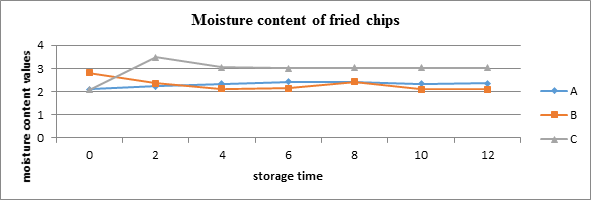
Studies on plantain chips fried with varietal stored tiger nut oil were studied. Three different tiger nut cultivars were sourced from Benue state and their oil extracted using hexane in an extractor. The stored oils were used to fry plantain chips after potatoes slicing and oil quality and stability analyzed. The moisture values of the chips from 0 week to week 12 for sample (A) ranged between 2.09-2.41 and 2.08-3.48 for samples (B) and (C) respectively .The thiobarbituric acid value from zero week - week12 for sample B O ranged between 0.19-0.21malon mg, sample BO ranged between 0.27-0.36 malon mg, while sample C ranged between 0.23-0.24malom mg. The appearance, aroma, taste, texture and overall acceptability of the chips ranged between 6.25-7.40, 6.20-6.55, 6.30-6.45, 6.20-6.55 and 6.15-6.55 respectively. Sample A and CKO (control) was most preferred in terms of appearance, aroma, taste, texture (crispness) and overall acceptability while sample A and C was least preferred. The sensory scores of the plantain chips fried with the oil were high for taste and aroma. During the storage, moisture values and thiobarbituric acid values of the chips were within the limits as recommended by CODEX Alimentarius.
Tiger nut (Cyperus esculentum) is a grass-like plant with spheroid tubers, pale yellow cream kernel surrounded by a fibrous sheath Nina et al (2019). It is also known as yellow nut sedge. Tiger nuts are edible, sweet, nutty, flavored tubers which contain nutrients (FAO, 2000). There are mainly three varieties namely: black, brown and yellow, and only yellow and brown are readily available in the Nigerian markets. Nina et al 2019. Plantain chips are the most popular plantain products in Nigeria. They are prepared by slicing ripened plantain with into diameter, 2mm and put in a vegetable oil at the temperature between frying temperature below flash point for 5minutes. The plantain chips prepared in this way are packed in plastics or in polyethylene bags and stored at 30+/-2 degrees C for 2-3months at room temperature respectively (Akubor and Adejo, 2000). However, the shelf life of plantain chips are reduced when exposed to light and air. The poor shelf life of plantain chips is due to lipid oxidation occasioned by the heat, oxygen, light, heavy metals, pigments, alkaline condition and degrees of unsaturation are catalyst in this process producing off flavors and odors called rancidity. This work seeks to investigate the quality of plantain chips when tiger nut –oil is used as a frying medium.
Procurement of Raw Materials
Brown and yellow tiger nuts were purchased from North bank market Makurdi, while the black tiger nut was purchased from Vande Ikya market, all in Benue State, Nigeria. They were taken to the Department of Agronomy, Federal University of Agriculture, Makurdi for identification. The plantain chips were bought from North bank market, in Makurdi.
Extraction of tiger nut oil
Tiger nut oil was extracted from the resulting flour using n hexane a non-polar solvent) according to AOAC, (2012) as presented in figure 2 0. Flour samples (1050g sample A, 1050g for sample B and 1050g for sample C) were used for extraction using a soxhlet extractor. The lipid was extracted for 5 hr. With a 500ml volumetric flask containing the solvent, which was heated with an electric heater at 70◦ C. Oil/solvent extracts were evaporated off using rotary evaporator and later oven dried at 105◦C for 1 hr. and stored in bottles to be analyzed later.
Determination of moisture value
Moisture content of tiger nut oil was determined by the AOAC Official method (2000). Into dried, and weighed moisture dish was added 5g tiger nut oil. This was heated in an oven Memmert, Germany at 105◦C for 1 hour, cooled in a desiccator containing phosphorus peroxide and weighed. This was repeated until a constant weight obtained.
Determination of moisture value
Moisture content of tiger nut oil was determined by the AOAC Official method (2000). Into dried, and weighed moisture dish was added 5g tiger nut oil. This was heated in an oven Memmert, Germany at 105◦C for 1 hour, cooled in a desiccator containing phosphorus peroxide and weighed. This was repeated until a constant weight obtained.
Moisture = % Moisture = Loss in mass on drying Weight of test sample ×100

= Ms-MhMs-Mt
Where,
Ms = Weight of moisture dish + Sample (g)
Mh = Weight of moisture dish +sample after heating (g)
Mt = Weight of Tare/moisture dish (g)
Thiobarbituric acid value
Thiobarbituric acid value was determined according to the method described by
Benchamaporn et al . (2009). A fifty (50) milligram sample was accurately weighed into a
Twenty-five milliliter volumetric flask and dissolved in a small volume of 1-butanol and made up to volume with 1-butanol. Then 0.5 mL of the sample solution was transferred to a dry test tube and 5 mL of TBA reagent solution (0.2883G/100ml of 90% glacial acetic acid) added. The test tube was closed with a ground-glass stopper, mixed thoroughly and placed in a thermostatic bath at 95°C. After 120 min, the test tube was removed from the thermostatic bath and cooled under running tap water for about 10 min until it reaches room temperature. The absorbance of the reaction solution was then measured at 530nm using distilled water in the reference cuvette. A reagent blank was also prepared and read. The result was calculated using the equation below:
TBAR value = TBAR value = [50×A-B]m

Where: A = absorbance of the test solution,
B = absorbance of the reagent blank, m = the weight (g) of the test sample.
Storage Studies
Plantain chips fried with tiger oil was packaged in a high density polyethylene and stored in a desiccator at room temperature (28◦C) for a period of three months (12 weeks). The samples were analyzed at two weeks interval to evaluate thiobarbutirc acid (TBA), and moisture content.
Sensory Evaluation
Unripe Plantain chips samples were fried with tiger nut oil and refined groundnut oil .The chips were evaluated on the basis of taste, flavor, appearance, texture and overall acceptability. Twenty (20) panelists were selected among the staff and students of Department of Food Science and Technology, Federal University of Agriculture, Makurdi. The plantain chips were evaluated using a nine point hedonic scale for sensory scoring (Iwe, 2002). Samples were served in a randomized manner on a tray
Statistical Analysis
All experiment was conducted in duplicate and subjected to analysis of variance (ANOVA) using statistical package of Social Sciences (SPSS) version 20.0. Means separation was done using Duncan Multiple Range Test and significant difference was established at p < 0.05.
Effect of Storage on the Moisture Content (%) of Plantain Chips Fried with Tiger oil cultivars
There was a significant (p<0.05) difference between the samples as storage time increased but the moisture content increased and decreased as the storage time increased. It was also in agreement with the acceptable limit for moisture content. The moisture content of food gives an indication of its shelf-life and nutritive value, hence low moisture content is a requirement for long storage life (Okene and Evbuomwan 2014).

Effect of Storage on the Thiobarbituric Acid (malon/mg) of the Plantain Chips Fried with Tiger Nut oil cultivars.
Result of the effect of storage of tiger oil on thiobarbituric acid values of the chips fried with tiger nut oils is shown in table 3.The thiobarbituric acid values of the chips from 0 to week 12 for black tiger nut oil ranged between 0.19 - 0.21malon mg, Brown tiger nut oil sample ranged between 0.27-0.36 malon/mg, while yellow tiger nut oil sample ranged between 0.23-0.24 malom/ mg. There was unsteady increase and decreased in thiobarbituic acid values in chips samples in Black oil and Brown oil
samples respectively, while Yellow sample increased during the storage period.
There was also a significant (p<0.05) difference between the chips samples as storage time increased. The thiobarbituric acid of the chips increased as the storage time increased. According to Valde´s et al. (2005), thiobarbituric value usually is more sensitive at the early stages of oxidation. Unsaturated fatty acids particularly linolenic acid is responsible for developing the colour clearly with thiobarbituric and the major compound formed such as malondialdehydes.

Effect of storage on the moisture content of plantain chips fried with tiger nut oil from different cultivars
There was a significant (p<0.05) difference between the samples as storage time increased According to (EAS, 2010) maximum moisture level for chips should not exceed 4.7 % (EAS, 2010). The moisture content of chips obtained in this study did not exceed the maximum limit, chips can be stored up to 5 months. Moisture content reflects shelf life of food materials, such as the rate of microbial spoilage of food products.
Sensory Properties of Plantain chips Fried with Tiger Nut Oil from Different
Cultivars
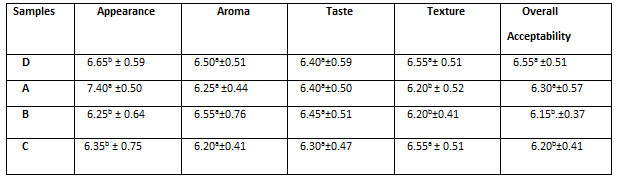
Results of the sensory scores of plantain chips fried with oils from different cultivars of tiger nuts and refined groundnut king oil (sample D as control) (Table 3) showed existing difference between them and the control. However, no significantly (P>0.05) different from their controls for most of the parameters evaluated. There was significant (p<0.05) difference in the appearance, aroma, texture, flavor and general acceptability of the chips fried with oil from sample A (black cultivar) and the refined oil (sample D). This indicates that tiger nut oil has good nutritive value and good for cooking hence, appearance is an important attribute in food choice and acceptance (Muhimbula et al., 2011).
Samples A and D were preferred in terms of appearance, aroma, flavor, texture and general acceptability.
Based on the aroma, there was no significant (p > 0.05) difference in all the samples. The aroma is an integral part of taste and general acceptance of the food before it is put in the mouth, hence test acceptability of formulated foods (Muhimbula et al., 2011). The tastes in all the samples were not significantly (p > 0.05) difference, based on the preference of the panelists. Taste is an important parameter when evaluating the sensory attribute of food .There was no significant (p> 0.05) difference in the texture of samples A (black cultivar) and B (brown cultivar) while there were no significant (p>0.05) difference in samples D (control) and C (yellow cultivar). This also could be as a result of difference in cultivar. The overall acceptability was significantly (p<0.05) different in all the samples. Samples A and D were preferred followed by sample C while sample B was least preferred.
The effect of storage on some of the quality parameters analyzed on the chips after frying showed that there were changes during storage but changes did not exceed maximum limits of CODEX Alimentarius. The sensory properties of the oil fried with plantain chips showed that the oil could be used as cooking and frying oils. It has good taste and aroma. Indicating that tiger nut oil is a good oil and can be important in providing food security, enhancing livelihoods, improving nutritional status and social wellbeing of vulnerable groups.
It was my pleasure to submit my testimonial concerning the Reviewer Board of our Scientific Journal “Brain and Neurological Disorders”. The Reviewers focused on some modifications and their contribution was helpful. The ladies of our Editorial Office were also supported my efforts. It was my honor to have such a co-operation and I am looking forward for more collaboration.

Dear Grace Pierce, Editorial Coordinator of Journal of Clinical Research and Reports, Thank you for the speedy and efficient peer review process. I appreciate the fact that your peer reviewers do not take months to respond like with some other journals. I would also like to thank the editorial office for responding quickly to my questions. It is an excellent journal. I plan to submit more manuscripts in the future. Best wishes from, Robert W. McGee

Dear Grace Pierce, Editorial Coordinator of Journal of Clinical Research and Reports, Working with you and your team on our recent publication in JCRR has been a truly wonderful and enjoyable experience. The responses were prompt, and the reviewers were patient, constructive, and highly professional. One reviewer in particular gave me the feeling that a professor was carefully reading and commenting on my coursework, which was deeply touching. The entire process was straightforward and hassle‑free, with no tedious online forms to complete. I highly recommend this journal. Best wishes from, DR Aibing Rao, Head of R&D

I Appreciate the Opportunity to Share my Experience with the Journal of Clinical Research and Reports. The peer review process was timely and constructive, and the feedback provided helped improve the quality of our manuscript. The editorial office was professional, responsive, and supportive throughout the process, ensuring smooth communication and efficient handling of the submission. Overall, it was a positive experience collaborating with your team.

Dear Mercy Grace, Editorial Coordinator of Obstetrics Gynecology and Reproductive Sciences, We would like to express our gratitude for your help at all stages of publishing and editing the article. The editors of the magazine answer all the necessary questions and help at every stage. We will definitely continue to cooperate and publish other works in the Obstetrics Gynecology and Reproductive Sciences! Best wishes from, Alla Konstantinovna Politova,

Dear Maria Emerson, Editorial Coordinator of International Journal of Clinical Case Reports and Reviews, What distinguishes International Journal of Clinical Case Report and Review is not only the scientific rigor of its publications, but the intellectual climate in which research is evaluated. The submission process is refreshingly free of unnecessary formal barriers and bureaucratic rituals that often complicate academic publishing without adding real value. The peer-review system is demanding yet constructive, guided by genuine scientific dialogue rather than hierarchical or authoritarian attitudes. Reviewers act as collaborators in improving the manuscript, not as gatekeepers imposing arbitrary standards. This journal offers a rare balance: high methodological standards combined with a respectful, transparent, and supportive editorial approach. In an era where publishing can feel more burdensome than research itself, this platform restores the original purpose of peer review — to refine ideas, not to obstruct them Prof. Perlat Kapisyzi, FCCP PULMONOLOGIST AND THORACIC IMAGING.