Research Article | DOI: https://doi.org/10.31579/2766-2314/078
1Young Researchers and Elite Club, Urmia Branch, Islamic Azad University, urmia, Iran
2Faculty of science, Urmia Branch, Islamic Azad University, Urmia, Iran
3Research Department of chromatography, Iranian Academic Center for Education, culture and Research, Urmia, Iran.
*Corresponding Author: Maryam Kouhkan, Young Researchers and Elite Club, Urmia Branch, Islamic Azad university, urmia, Iran.
Citation: Maryam Kouhkan, A Souldozi, H Alizadeh. (2022) Antibacterial Activity Of 1,3,4-Oxadiazole Derivatives Against Methicillin-Resistant Staphylococcus Aureus. J. Biotechnology and Bioprocessing, 3(3); DOI:10.31579/2766-2314/078
Copyright: © 2022 Maryam Kouhkan, This is an open-access article distributed under the terms of the Creative Commons Attribution License, which permits unrestricted use, distribution, and reproduction in any medium, provided the original author and source are credited.
Received: 26 April 2022 | Accepted: 20 May 2022 | Published: 09 June 2022
Keywords: 1,3,4-oxadiazol; staphylococcus aureus; antibiotic resistance
Background: Antimicrobial resistance is a major problem in treatment and public health, which has been increasing over the last few decades so we need to take a very serious strategy to overcome this challenge. We have previously synthesized new series of (5-aryl-1,3,4-oxadiazol-2-yl) (pyridin-2-yl) methanol derivatives (4a-4f) in fairly high yields. Here, we have evaluated the antibacterial activity of these derivatives against methicillin-resistant Staphylococcus aureus.
Methods: The agar well diffusion and agar dilution methods were used for determination of inhibition zoon (IZ) and minimum inhibitory concentration (MIC) of compounds during preliminary evaluation of antibacterial activity.
Results: The title compounds have exhibited significant antibacterial activity against methicillin-resistan Staphylococcus aureus.
Conclusions: The results show that the synthesized compounds can be suitable options for preparation of selective inhibitor antibiotics of methicillin-resistant Staphylococcus aureus.
Staphylococcus aureus is a common pathogenic bacteria that causes a wide variety of human infections including, cellulitis, boils, infective endocarditis, toxic shock syndrome, surgical site infections, endocarditis, osteomyelitis and septic arthritis [1].The world spread use of antibiotics play a major role in leading to emergence of drug-resistant pathogens such as methicillin-resistant Staphylococcus aureus (MRSA). MRSA is a major global health threat that become as a world concern and important challenge in the pharmacy world. MRSA and other antibiotic-resistant infectious bacteria has become broadly resistant to many types of antibiotics and make medications ineffective. Because of this problem we need to develop new antibiotic formulation to fight this epidemic.
Due to increasing of microbial resistance to existing antibiotics, new chemical compounds have been synthesized by oxadiazol with different aromatic substituted with a wide range of biological activities such as antibacterial [2], antifungal [3], analgesic [4], anti-inflammatory [5], antiviral [6], anticancer [7], antihypertensive [8], anticonvulsant [9] and
anti-diabetic properties [10]. Research revealed that heterocyclic compounds containing halogen atoms are unique option due to halogens operation to act as hydroxy mimic agent. So substitution of halogens by oxadiazol and pyridine substituents have impressive role in designing new pharmacophores as antimicrobial agents. In our previous study, we synthsised (5-aryl-1,3,4-oxadiazol-2-yl) (pyridin-2-yl) methanol, in a one-pot reaction and evaluated their antimicrobial activity against some patojenic microorganism [11,12]. Follow these study we continued our research to evaluate the antibacterial activity of these antimicrobial agents against MRSA.
Chemistry:
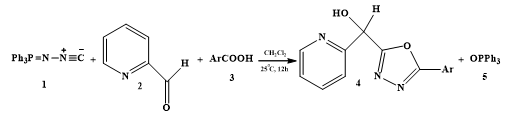
A group of (5 aryl 1,3,4 oxadiazol 2 yl)(pyridin 2 yl)methanol derivatives 4a-4f (Ar: (a=4- CH2-Ph), (b=3-CH2-Ph), (c= 5-Naphthalen), (d=4-Br-ph), (e=3-Br-ph), (f= ph))were synthesized using previously published methods [11,12](Scheme 1).

Antibacterial Activity:
Agar Diffusion Method
Antibacterial activity of title compounds were tested against MRSA ATCC 700698. This bacterium was obtained from Shiraz University of Medical Sciences. The standardization of bacterial inoculum was done following the to Clinical & Laboratory Standards Institute (CLSI). Briefly, bacterial strain were inoculated into Mueller Hinton broth (MHB) and then were incubated for 12 h at 35 oC to achieve the turbidity of 0.5 McFarland units. Standardized bacterial inoculum by concentrations of 1.5×10⁸ cfu/mL (colony-forming units per milliliter, CFU/mL) colony was used for antibacterial screening. The antibacterial activity of the prepared compounds were screened using the well diffusion method [13-15]. In the first, the compounds, Ceftizoxime and ciprofloxacin were dissolved in dimethyl sulfoxide (DMSO) to get solutions with concentration of 1mg/ml. Melted and sterilized Muller Hinton Agar (MHA, Merck, Germany) (250 ml) was transferred into sterile Petri dish and seeded with 100 µl inoculum, containing 1.5×10⁸ cells/ml of bacteria. After making wells in agar, 70 µl of compounds was transferred to each well, and 70 µl of DMSO was inoculated into another well as a negative control. In the last step the antibacterial potential of compounds was determined by measuring the zone around each well in millimeters after incubation for 24h. Ceftizoxime and ciprofloxacin used with the same method as broad-spectrum standard antibacterial agents. Experiments performed at least three times and data were expressed as mean±standard deviation.
Determination of Minimum Inhibitory Concentration of Compounds
In the second step, the MICs of the title compounds plus reference drugs were determined by agar dilution method. Experiments were performed with eight different concentrations of title compounds, Ceftizoxime and ciprofloxacin (1000, 500, 250, 125, 62.5, 31. 25, 15 and 7 µg/mL) to prepare doubling serial dilutions. In both methods Negative and Positive Control plate were prepared in the same way and Concentrations as compounds. Agar dilution plates were incubated at 37OC for 18h. The MIC was recorded as the lowest concentration of compound that inhibited bacterial growth completely [16,17].
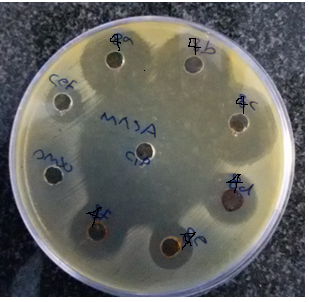
The emergence of Antibiotic resistance is occurring in all parts of the world and menace the effectiveness of drugs to treat common infectious diseases. This crisis is result of overuse and misuse of treatment by these medications. The Centers for Disease Control and Prevention (CDC) publishes list of bacteria which new antibiotics are urgently needed and methicillin-resistant Staphylococcus aureus has classified in critical group. This pathogenic bacterium has become resistant to most antibiotics, but the remarkable point about this microorganism is its resistance to all beta-lactam antibiotics such as penicillins and cephalosporins [18]. This crisis make us to move towards the non-benalactam antibiotics. We have previously demonstrated that the novel synthesized oxadiazol compounds by our research group, possess antimicrobial activity against Staphylococcus epidermidis, Bacillus cereus , Pseudomonas aeruginosa, Staphylococcus aureus, Escherichia coli, Candida tropicalis and Candida albicans.In this study all the synthesized compounds (4a-4f) were evaluated for their in vitro antibacterial activity against methicillin-resistant Staphylococcus aureus and the results were summarized in Chart 1and 2. The results revealed that all tested compounds have significant antimicrobials activity against Staphylococcus aureus with IZ values in the range of 16 -25, All tested compounds (4a-4f) inhibit the growth of MRSA but compounds 4a, 4b and 4C have shown more promising antimicrobial activity with MIC values of of 62µg/ mL. The antibacterial screening results demonstrated that antibacterial activity of above compounds are notably more as compared to standard drugs Ceftizoxime however, they showed poor activity compared with ciprofloxacin (Figure 1). No zone of inhibition was seen around the well containing DMSO (Negative control).
The results of the study revealed that the presence of lipophilicity moiety like: 4-phenyl methyl (4a), 3-phenyl methyl (4b) and 5-naphthalene (4c) increase the antimicrobial activity of compounds against MRSA. Additionally, nitrogen atom of pyridine moiety enhance the antimicrobial activities of title oxadiazol derivatives, which can be attributed to charge delocalization and conversion in chemical structure [19]. As mentioned before, in addition to the high antimicrobial power of the tested derivatives, the proposed one-step method for the synthesis of compounds, can provide an efficient and impressive method for other pharmaceutical fields with time efficiency and less energy input. Continuation of study is required to evaluate the synergistic effect of synthesized compounds, and assess their safety and efficacy.


The results show that these newly synthesized compounds could be good option toward the development of non-β-lactam antibiotics for treatment of infections caused by MRSA or enhancement of conventional antibiotics activity against MRSA.
The authors gratefully thank the Azad university of Urmia for providing this research.
No manipulation or something similar were carried out on any animals.
This article does not contain any studies involving animals performed or human participants performed by any of the authors.
The authors received no specific funding for this work.
We declare that we have no conflict of interest and the ethical principles for this research have been respected.
It was my pleasure to submit my testimonial concerning the Reviewer Board of our Scientific Journal “Brain and Neurological Disorders”. The Reviewers focused on some modifications and their contribution was helpful. The ladies of our Editorial Office were also supported my efforts. It was my honor to have such a co-operation and I am looking forward for more collaboration.

Dear Grace Pierce, Editorial Coordinator of Journal of Clinical Research and Reports, Thank you for the speedy and efficient peer review process. I appreciate the fact that your peer reviewers do not take months to respond like with some other journals. I would also like to thank the editorial office for responding quickly to my questions. It is an excellent journal. I plan to submit more manuscripts in the future. Best wishes from, Robert W. McGee

Dear Grace Pierce, Editorial Coordinator of Journal of Clinical Research and Reports, Working with you and your team on our recent publication in JCRR has been a truly wonderful and enjoyable experience. The responses were prompt, and the reviewers were patient, constructive, and highly professional. One reviewer in particular gave me the feeling that a professor was carefully reading and commenting on my coursework, which was deeply touching. The entire process was straightforward and hassle‑free, with no tedious online forms to complete. I highly recommend this journal. Best wishes from, DR Aibing Rao, Head of R&D

I Appreciate the Opportunity to Share my Experience with the Journal of Clinical Research and Reports. The peer review process was timely and constructive, and the feedback provided helped improve the quality of our manuscript. The editorial office was professional, responsive, and supportive throughout the process, ensuring smooth communication and efficient handling of the submission. Overall, it was a positive experience collaborating with your team.

Dear Mercy Grace, Editorial Coordinator of Obstetrics Gynecology and Reproductive Sciences, We would like to express our gratitude for your help at all stages of publishing and editing the article. The editors of the magazine answer all the necessary questions and help at every stage. We will definitely continue to cooperate and publish other works in the Obstetrics Gynecology and Reproductive Sciences! Best wishes from, Alla Konstantinovna Politova,

Dear Maria Emerson, Editorial Coordinator of International Journal of Clinical Case Reports and Reviews, What distinguishes International Journal of Clinical Case Report and Review is not only the scientific rigor of its publications, but the intellectual climate in which research is evaluated. The submission process is refreshingly free of unnecessary formal barriers and bureaucratic rituals that often complicate academic publishing without adding real value. The peer-review system is demanding yet constructive, guided by genuine scientific dialogue rather than hierarchical or authoritarian attitudes. Reviewers act as collaborators in improving the manuscript, not as gatekeepers imposing arbitrary standards. This journal offers a rare balance: high methodological standards combined with a respectful, transparent, and supportive editorial approach. In an era where publishing can feel more burdensome than research itself, this platform restores the original purpose of peer review — to refine ideas, not to obstruct them Prof. Perlat Kapisyzi, FCCP PULMONOLOGIST AND THORACIC IMAGING.